Why Your Heart Loves a Long Exhale
Understanding Heart Rate Variability: Why It Matters for Yoga, Health, and How We Practice
5-minute read /20-minute podcast
This week we to explored heart rate variability (HRV) a term you may be hearing more often across yoga, yoga therapy, and wider mind–body or integrative health spaces.
Despite its growing popularity, HRV is often misunderstood, largely because it sits at the intersection of physiology, neuroscience, and practice. But when understood clearly, it becomes incredibly useful. It can shape how you practice, how you teach, and how you speak about yoga in relation to health and medicine.
The evidence base here is moderate. Core concepts, what HRV is and how breathing influences it, are well established and supported by clinical reviews and consensus papers. Evidence linking yoga to improved HRV is also consistent, though more variable due to differences in study design and practice type. Age-related decline is well supported, but specific patterns should be treated as trends rather than fixed rules. Overall, this provides a credible, evidence-informed foundation, best framed as strong but still evolving rather than definitive.
What is Heart Rate Variability?
At its simplest, heart rate variability is exactly what it sounds like: variation in heart rate.
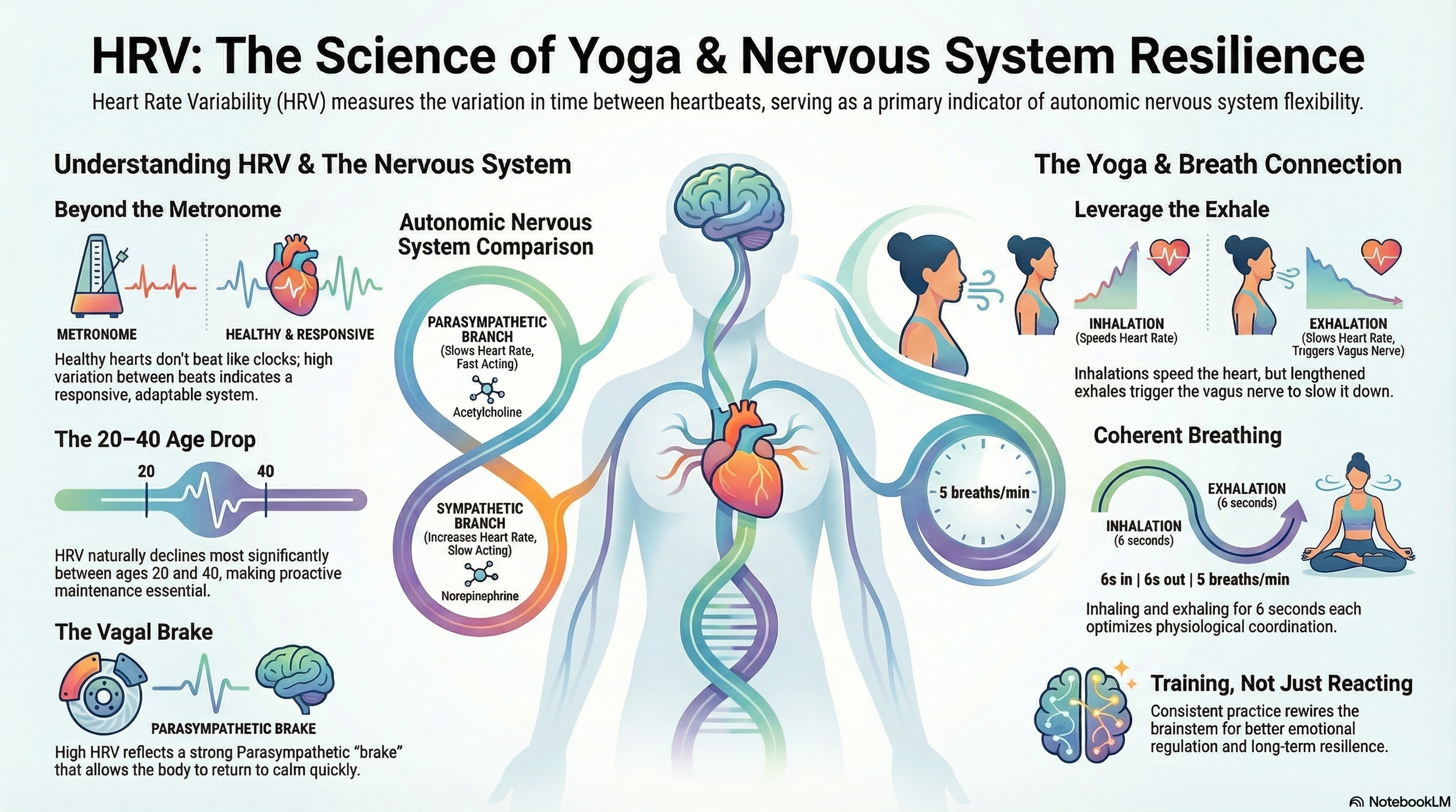
More precisely, it refers to the variation in time between successive heartbeats. Even when your heart rate appears steady, the intervals between beats are constantly changing. This is normal—and essential.
From a physiological perspective, HRV is often described as the variation between “RR intervals” on an ECG. These intervals represent the time between key electrical signals that trigger each heartbeat.
So rather than thinking of the heart as beating like a metronome, HRV reminds us that a healthy heart is actually dynamic and responsive.
Why HRV Matters
Heart rate variability is one of the most important indicators we have of autonomic nervous system flexibility.
In practical terms, it reflects your ability to:
Mobilise energy when needed (e.g. to act, think, respond)
Return to a state of calm when that energy is no longer required
High HRV is associated with:
Greater psychological resilience
Better adaptability to stress
Improved cardiovascular health
Overall wellbeing
Low HRV is associated with:
Poor mental and physical health
Reduced adaptability (getting “stuck” in stress or shutdown)
Links in research to trauma and conditions such as PTSD
Poor cardiovascular function
HRV also naturally declines with age, with the most significant drop typically occurring between ages 20 and 40. However, while we cannot stop this decline entirely, we can slow it down and even improve HRV through specific practices.
The Mechanism: Your Nervous System at Work
HRV is driven by the ongoing interaction between two branches of the autonomic nervous system:
1. Parasympathetic Nervous System (Vagus Nerve)
Slows the heart rate
Uses the neurotransmitter acetylcholine
Acts quickly and has a strong influence
2. Sympathetic Nervous System
Increases the heart rate
Uses norepinephrine
Acts more slowly and with less dominance
These two systems are constantly interacting—speeding the heart up and slowing it down in a dynamic, ongoing rhythm.
👉 HRV reflects this “pendulation” between the two systems.
👉 The greater the variation, the greater the flexibility.
A key point here is that the vagus nerve has a stronger and faster effect. So when we talk about increasing HRV, we are largely talking about enhancing vagal influence.
The Critical Role of Breathing
One of the most powerful—and practical—ways to influence HRV is through breathing.
There is a well-established physiological phenomenon called respiratory sinus arrhythmia, which describes how breath directly affects heart rate:
Inhalation → heart rate increases
Exhalation → heart rate decreases
Importantly, the exhale has a stronger effect because it increases vagal activity.
This means that every breath you take is already influencing your HRV—but how you breathe determines the extent of that influence.
Why the Exhale Matters More
During exhalation:
The brainstem increases signalling through the vagus nerve
More acetylcholine is released
The heart rate slows more significantly
During inhalation:
Vagal signalling reduces
Heart rate increases
Because the parasympathetic system (via the vagus nerve) has the stronger influence, the exhale becomes the most powerful lever for increasing HRV.
Practical Application in Yoga
This is where HRV becomes highly relevant to yoga practice and teaching.
The key principle:
➡️ Lengthening the exhale increases heart rate variability
This can be applied in multiple ways:
1. During postures (āsana)
Especially in challenging poses
Helps balance sympathetic activation (effort) with parasympathetic regulation (calm)
Supports presence and reduces overwhelm
2. In restorative practices
Enhances relaxation
Deepens parasympathetic activation
3. In breathwork (prāṇāyāma)
Directly trains the nervous system
Builds long-term regulation capacity
What Happens Over Time
With consistent practice:
The brainstem adapts (not just the vagal pathways, but wider networks)
Resting HRV increases
The nervous system becomes more flexible overall
This leads to:
Better emotional regulation
Improved cognitive function (linked to the prefrontal cortex)
Greater resilience
Improved cardiovascular health
In essence, you are training your system to become more responsive rather than reactive.
Beyond Breath: Other Influences on HRV
While breath is a powerful tool, it’s not the only factor.
HRV is also influenced by:
Sleep
High-quality sleep significantly improves HRV
Yoga can improve sleep, creating a positive feedback loop
Physical activity
Aerobic exercise increases HRV
Sedentary behaviour reduces it
Coherent breathing
Around 5 breaths per minute (e.g. inhale 6 seconds, exhale 6 seconds)
One of the most effective techniques for increasing HRV
Works through additional physiological mechanisms beyond basic breath–heart interaction
Why This Matters for Practice and Teaching
Understanding HRV does more than deepen your personal practice—it changes how you communicate and apply yoga.
It allows you to:
Teach with physiological clarity, not just intuition
Make more intentional decisions about breath cues and sequencing
Support students in a more targeted, evidence-informed way
Speak credibly with healthcare professionals about yoga’s role in health
Bringing It All Together
Heart rate variability is a measure of how adaptable your system is.
A higher HRV means:
You can shift between effort and ease
You can meet the demands of life without becoming stuck in stress
Your body and mind are working in a coordinated, flexible way
And importantly:
Yoga—especially through breath and the elongation of the exhale—can directly improve this capacity.
If you’re practicing or teaching, this gives a clear, grounded rationale for something you may already be doing:
Slow down the breath.
Lengthen the exhale.
Support the system to become more adaptable.
That is where much of the power lies.