The Way Out Is In!
The Way Out Is In: What the Ashtanga Series Is Really Teaching Us ( a summary of week 3 of the Yoga for Life Program)
“The way out is in.”
— Thich Nhat Hanh
Listen to a 22-minute podcast-style discussion here
It’s a deceptively simple phrase. One that can feel almost contradictory in a world that constantly pulls us outward—towards productivity, progress, and external markers of success. And yet, within practice—within the steady rhythm of the Ashtanga series—we begin to understand that this is not just philosophy. It is something we can experience directly.
Because Ashtanga is not simply a collection of postures. It is a method.
A structured, repeating sequence where breath, movement and attention are woven together. The same postures, in the same order, practised over time. Not to perfect the shape, but to shift where we are paying attention. The external structure stays consistent so that something internal can begin to change.
Over time, the question subtly moves from “what am I doing?” to “what am I noticing?”
This is the work.
The term “Ashtanga” comes from Sanskrit:
“Ashta” = eight
“Anga” = limbs
This refers to the Eight Limbs of Yoga from Yoga Sutras of Patanjali, which include ethics, discipline, posture, breath, and meditation.
The Core Method: Why It’s Always the Same Sequence
Unlike many modern classes, Ashtanga uses set sequences:
Primary Series (Yoga Chikitsa – “therapy”)
Intermediate Series (Nadi Shodhana – “nervous system purification”)
Advanced Series (Sthira Bhaga – “strength and grace”)
Why fixed sequences matter:
You stop thinking “what comes next?”
Attention shifts from novelty → internal experience
Progress is measured through depth, not variety
This is key: Repetition is the mechanism for insight.
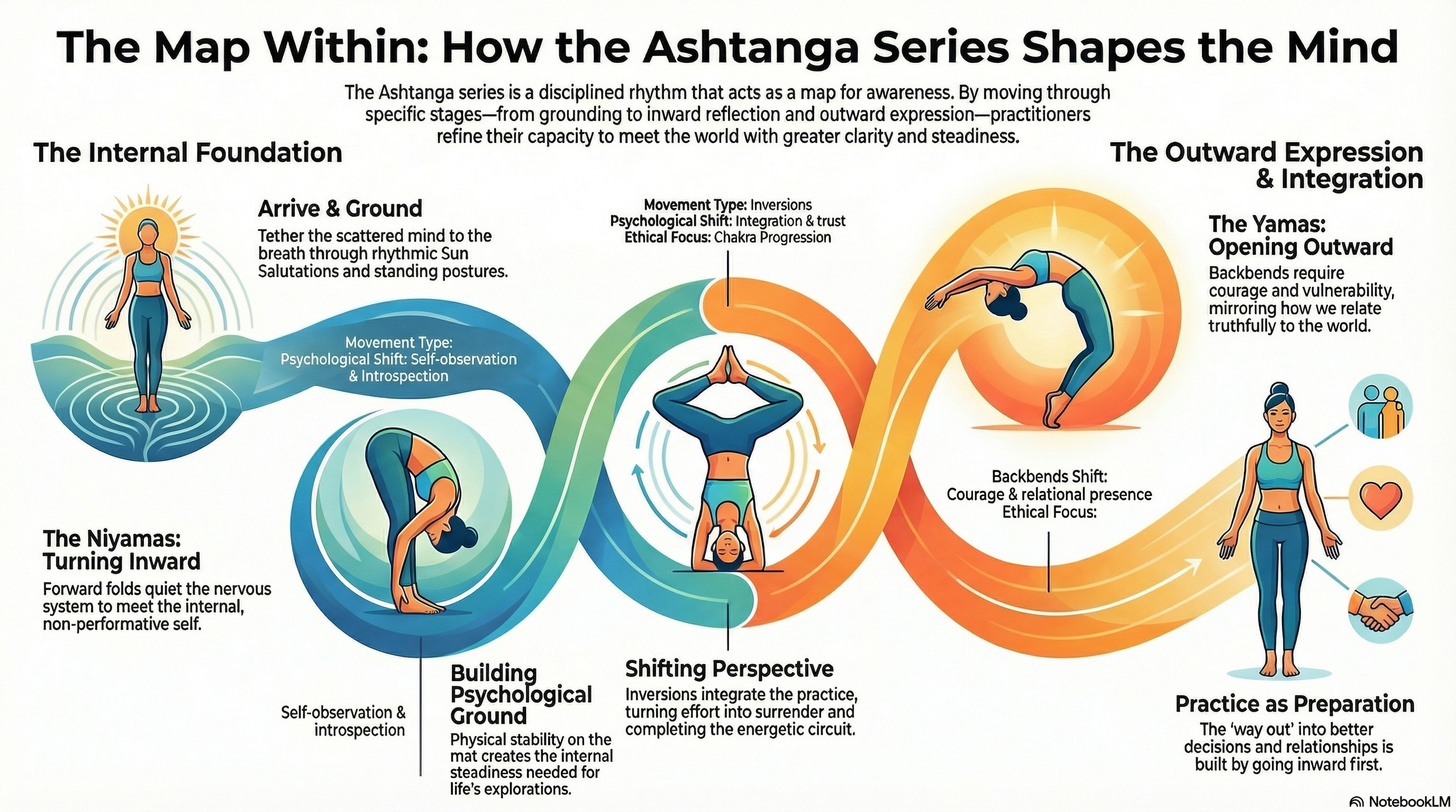
Arriving: The First Turn Inward
We begin with the sun salutations. Repetitive, rhythmic, breath-led.
At first, they feel like a warm-up. But very quickly they become something else—a way of arriving. The mind, which may have come in scattered, begins to gather. The breath becomes the anchor. Heat builds, and with it, a sharpening of awareness.
This is the first layer of turning inward. Not deep yet, but deliberate.
Grounding: Building Stability in the Standing Series
From there, we stand.
The standing postures organise us. Feet root down, legs engage, the spine lifts. These shapes ask us to stabilise—to find balance, orientation and clarity in space.
This is where we build ground.
Not just physically, but internally. The capacity to stay, to hold attention, to be steady even when things feel effortful. Without this grounding, it is difficult to go further—either inward or outward.
Looking In: Forward Folds and the Niyamas
Then we begin to fold.
Forward bends draw the body inward and, with it, the attention. The nervous system quiets. The gaze softens. There is less to “do” and more to feel.
This is where we meet the inner landscape.
In the language of yoga philosophy, this aligns with the niyamas—self-study, discipline, contentment. But in practice, it is often much simpler and more honest than that. It is noticing where we hold tension, where we resist, where we push, and where we might soften.
Here, “the way out is in” becomes real. The insight does not come from outside. It comes from paying attention.
Looking Out: Backbends and the Yamas
If forward folds take us inward, backbends begin to turn us outward.
They open the front of the body—the chest, the throat, the belly. Places we instinctively protect. They ask for a different kind of effort. Not contraction, but expansion. Not control, but courage.
This is where the yamas—how we relate to the world—start to be felt. Openness, honesty, vulnerability.
Backbends are not just physical shapes. They are relational gestures. Having turned inward, we begin to open outward again.
Integration: Inversions and the Full Cycle
Eventually, we turn upside down.
Inversions shift perspective completely. What was stable becomes unfamiliar. What felt certain requires trust. Effort and surrender begin to meet.
This is where the practice starts to integrate.
Across the sequence, there is a natural movement—grounding, turning inward, opening outward, and then integrating it all. Many describe this as moving through the energetic system of the body, a kind of rising and circulating awareness often linked to the chakras.
Whether or not we use that language, the experience is clear: something is being connected.
Why the Sequence Matters
One of the most powerful aspects of Ashtanga is that it does not change.
The same sequence, again and again.
At first, this can feel repetitive. But over time, it becomes the very thing that allows depth. Without novelty, we begin to notice more. The breath. The subtle shifts. The habits. The edges.
And importantly, we begin to see that no two bodies experience the same posture in the same way. Our structure—our bones, proportions, and patterns—shapes what is possible and what is felt.
Practice then becomes less about achieving a universal shape, and more about understanding our shape.
There is a quiet invitation here: to work with the body we have, not the one we think we should have.
The Full Arc: In, Out, and Through
So the sequence is not just physical.
It is cyclical.
We arrive.
We ground.
We turn inward.
We open outward.
We integrate.
And then we begin again.
Over time, this repetition builds something subtle but powerful—not just strength or flexibility, but awareness. A kind of energy and clarity that develops through consistent, attentive practice.
Not forced. Not dramatic. Just cultivated.
So What Does “The Way Out Is In” Mean?
It doesn’t mean withdrawing from the world.
It means that the quality of how we meet the world is shaped internally.
The steadiness we build in standing.
The honesty we meet in forward folds.
The openness we practise in backbends.
The perspective we gain when things turn upside down.
These are not confined to the mat.
They are rehearsals for how we live.
The “way out”—into clearer decisions, more grounded relationships, a deeper sense of ease—is not found by pushing further outward.
It is built, quietly and consistently, by turning inward first.
And then returning.
Practice is not escape.
It is preparation.