Rewiring the Anxious Brain: Why Yoga Works Better Than You Think
3-minute read
If you have ever walked into a yoga class feeling like a tangled ball of tension and walked out feeling calmer, softer and strangely more optimistic about life, the explanation is not mystical. It is neuroscience. Your brain is constantly remodelling itself in response to how you move, breathe and focus. This ability is called neuroplasticity, the brain’s ability to change in response to experience.
Every time you step on your mat, you are influencing which pathways strengthen, which weaken and which new connections might form. This means yoga is not just stretching. It is literally rewiring you.
Anxiety, however, works hard to rewire you in the opposite direction.
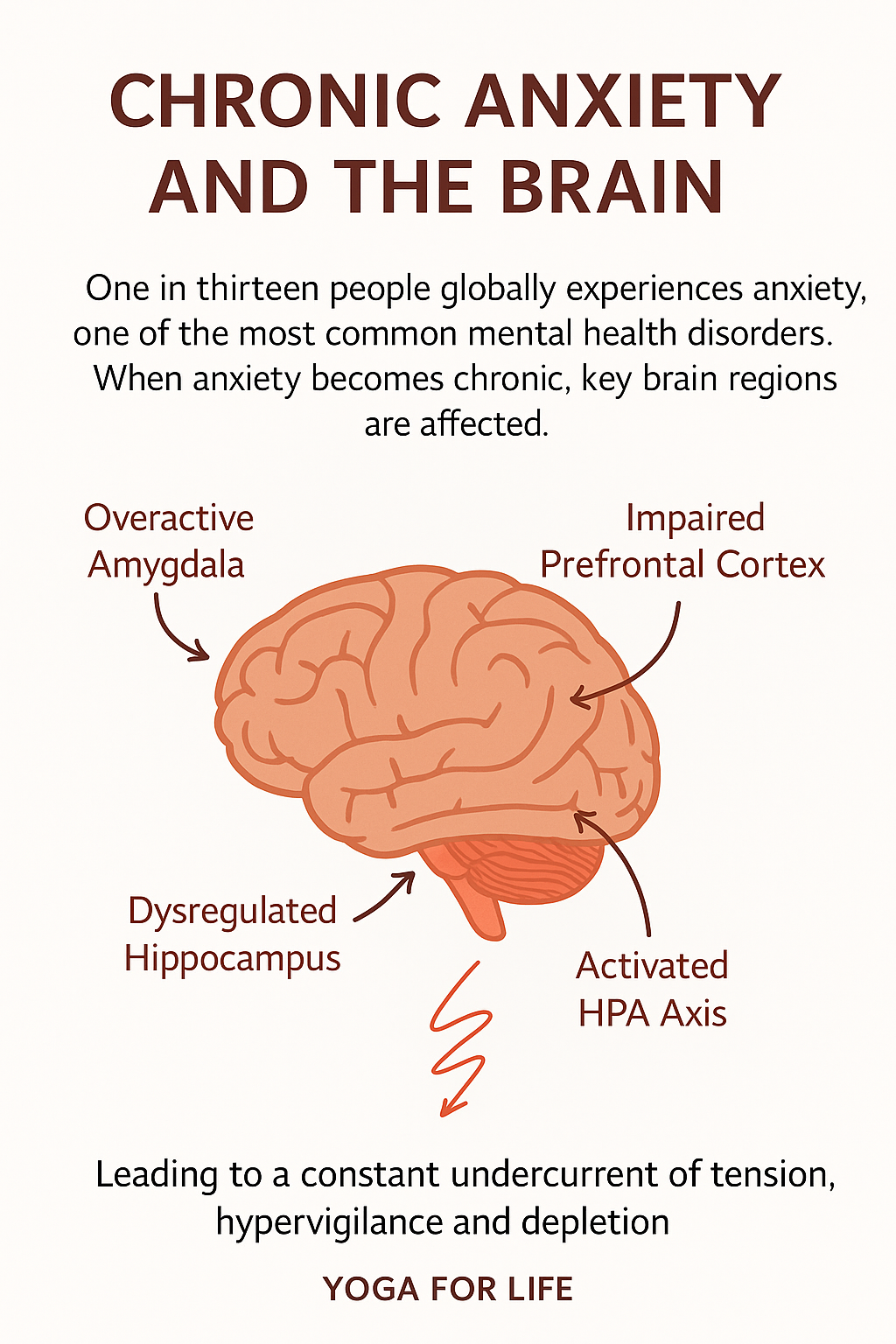
When anxiety becomes chronic, the brain’s alarm system becomes overly sensitive. The amygdala fires too often, the prefrontal cortex struggles to apply rational thought, and the hippocampus, responsible for memory and emotional regulation, becomes vulnerable to stress hormones. The body’s main stress pathway, the HPA axis, stays switched on, leading to a constant undercurrent of tension, hypervigilance and depletion, all clearly shown in your original slides.
This is where yoga becomes powerful. Yoga works both from the bottom up and the top down. Your slides show this beautifully. Bottom up means changing signals from the body to the brain. Slow, deliberate breathing activates the vagus nerve and shifts the nervous system toward rest, repair and regulation. When you elongate your exhale, your vagus nerve fires more strongly and sends a message of safety to the brain. This is one of the simplest and most effective tools you can use in anxious moments.
Top-down mechanisms involve mindfulness and attention. When you bring awareness to the sensations in your body, the quality of your breath or the pattern of your thinking, you strengthen the prefrontal cortex. This gives you more capacity to notice stress before it overwhelms you, to reframe fear and to stay grounded in the present. It is the psychology of self-regulation delivered through movement and breath.
In simple terms, when you move consciously and breathe with intention, your brain becomes more resilient. You become better at handling stress, recovering from challenge and meeting life with steadiness.
The real takeaway is this. You are not stuck with the brain chemistry you woke up with. Yoga gives you an accessible and compassionate way to influence your inner world. One breath invites safety. One movement nurtures clarity. One moment of awareness strengthens the pathways that help you feel like yourself again.
Your brain is designed to change, and yoga is one of the most elegant ways to help it do exactly that.