How Yoga Becomes a Habit: The Psychology of Making Wellbeing Stick
3-minute read OR Listen Here
Imagine this:
You unroll your mat right after you put the kettle on in the morning.
You breathe deeply the moment you get into bed.
You stretch as soon as you’ve finished work.
We often treat yoga, breathwork, and wellbeing practices as things we “should” do, when we have time, when life calms down, when motivation magically appears. But motivation is unreliable. It rises and falls with mood, energy, hormones, stress, seasons, even the weather. It cannot carry a lifelong practice.
Habits can.
A habit is not something you do frequently. It is something you do automatically, triggered by a contextual cue your brain has learned to associate with the action. Yoga researchers, psychologists and neuroscientists have been studying this for years. What they’ve found is simple: repeat a behaviour in the same context and your brain will learn to do it without asking your permission.
I like to feel my footprints standing at the coffee machine, then I sit and hug my coffee mug and take some long, slow breaths ( I also have to have my favourite hugable mug).
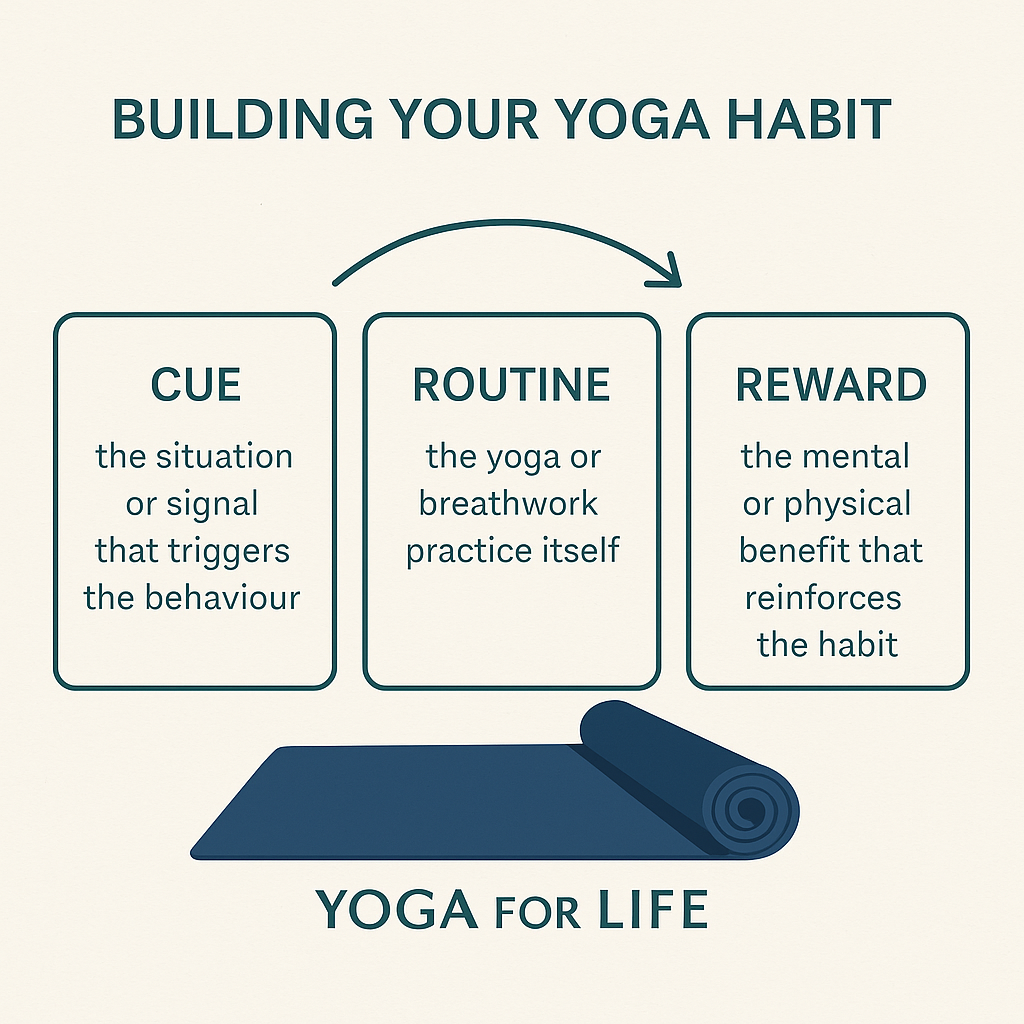
Once a wellbeing practice becomes tied to a cue, your brain shifts responsibility from intention to automaticity. This is why the behaviour continues even when motivation disappears. Your brain isn’t checking in with you, t’s simply running a well-worn neural pathway.
This is incredibly powerful for yoga and breathwork, because these practices produce measurable physiological benefits only when done consistently.
Breath regulates the vagus nerve. Movement improves emotional stability. Mindfulness strengthens the prefrontal cortex. But consistency is the mechanism that allows this to happen.
In a recent study, people repeated tiny mobility behaviours daily; those behaviours became so automatic that participants described them as “second nature,” “part of me now,” or “strange not to do.” Once the habit formed, it no longer required effort, the brain had taken over.
This translates beautifully to yoga.
You don’t build a practice by waiting to feel inspired.
You build it by anchoring small rituals to cues:
Roll your mat out after breakfast.
Take three long breaths before opening your laptop.
Do a gentle stretch sequence before bed.
End your workday with child’s pose and an exhale twice as long as your inhale.
Here's one of mine: I have a yoga strap that lives in my laptop bag, so I see it, and I do shoulder mobility circles a few times a day.
The goal isn’t intensity, it’s automaticity.
Wellbeing habits also have a second layer of support: neurobiology. Once actions become automatic, the brain conserves cognitive resources. This makes it easier to maintain emotional balance, resist stress, and focus attention — all core benefits of yoga. The automation frees up mental space for reflection, presence, or simply breathing more consciously.
Every time you repeat a yoga or breathwork practice in a stable context, you strengthen a neural pathway that says, “This is what I do now.” Over time, the practice becomes who you are rather than something you must remember to do.
The real secret is this:
You don’t need to be disciplined. You need to be consistent with a cue.
Habits change the brain.
Yoga changes the nervous system.
Together, they change your life, quietly, steadily, one repetition at a time.