How Sequencing Strengthens Cognition as We Age
4-minute read.
If you’ve ever finished a yoga class feeling clearer, sharper or more “together” than when you walked in, that wasn’t an accident. Yoga is not just movement; it’s coordination, memory, breath regulation, sensory awareness, emotional processing, and attention training happening all at once.
And this matters deeply for our brains, especially as we age.
Research shows that the human brain begins to naturally atrophy from our 30s onward, with the frontal and temporal regions, those involved in attention, planning, and memory, being among the most vulnerable. Cognitive skills like switching attention, problem solving, and working memory gradually decline. For some, this decline accelerates into conditions like Mild Cognitive Impairment or Alzheimer’s Disease, where spatial working memory becomes particularly affected.
But here’s the hope: movement that challenges the brain while engaging the body is one of the most protective things we can do.
Why Yoga Is a Cognitive Workout
Yoga isn’t just exercise; it’s inherently dual-task training. You’re moving and thinking. You’re coordinating breath with intention, shaping postures, remembering sequences, adjusting balance, and monitoring internal experience.
Studies show that performing cognitive and physical tasks simultaneously can boost executive function and spatial working memory, especially when coordination and sequencing are involved. This is the same cognitive domain often impacted earliest in Alzheimer’s disease.
Yoga, in other words, is a beautifully designed cognitive-motor training system thousands of years old.
The Power of Intelligent Sequencing
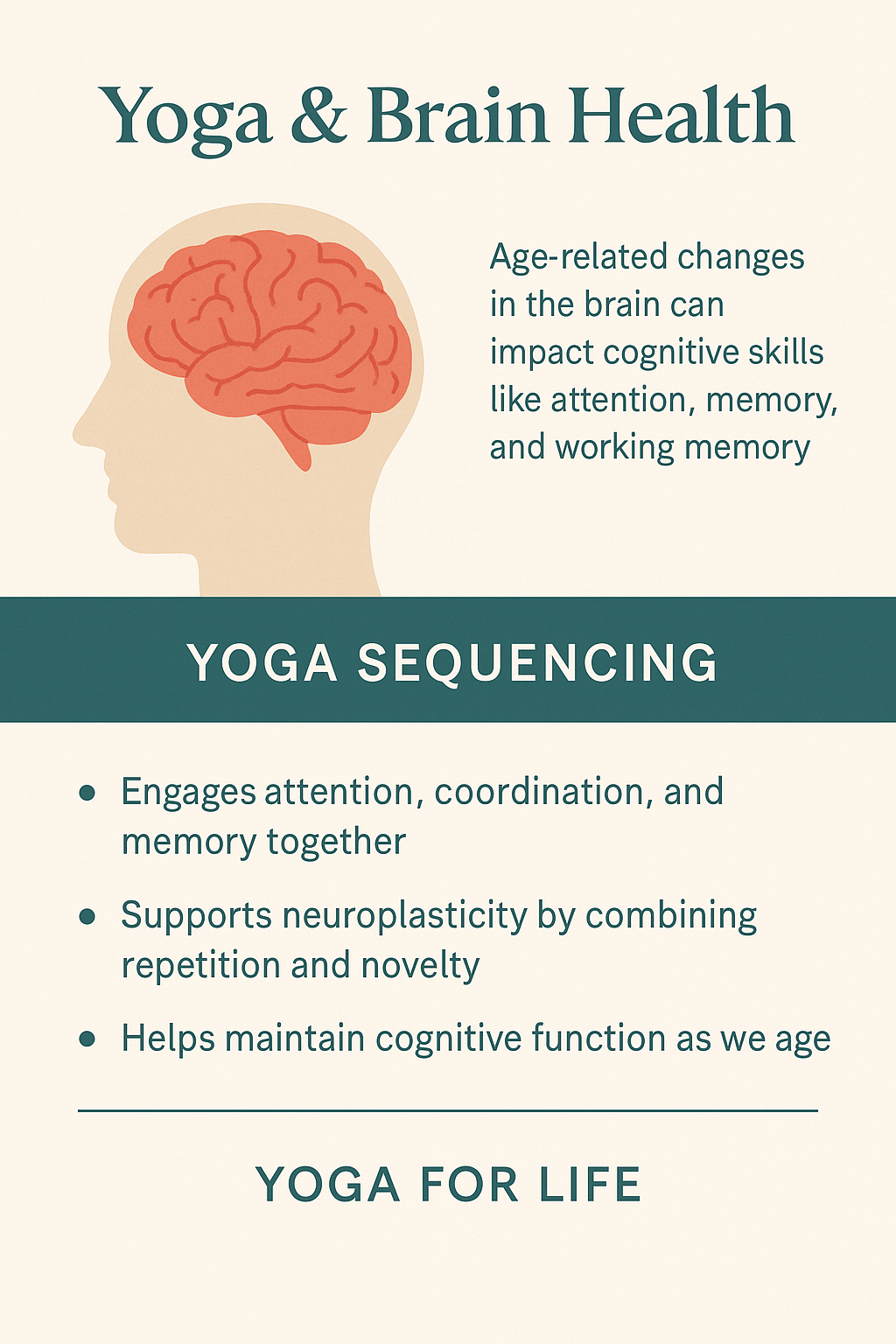
When you practise a yoga sequence, your brain must:
1. Hold information online (working memory).
You remember which pose comes next, how to transition, and how to refine it.
2. Switch attention.
Breath → alignment → balance → teacher cues → internal experience.
3. Integrate sensory input.
Proprioception (where your body is in space) heavily recruits the parietal and frontal lobes—regions that decline faster with age.
4. Chunk information.
Over time, your brain starts to organise sequences as “units” ("Sun Salutation A" rather than 12 separate steps). Chunking is a key feature of a healthy episodic buffer, a system that becomes less efficient in early cognitive decline.
Sequencing, then, is not just artistic choreography; it’s cognitive resilience training.
Repetition + Novelty = Neuroplasticity
The brain thrives on a balance of familiarity (security) and novelty (challenge). Yoga sequencing does exactly this:
You repeat postures to strengthen neural pathways.
You encounter new variations to stimulate cognitive flexibility.
You connect breath and movement to regulate the stress system, which protects memory-related structures like the hippocampus.

Author: Emily.
Working at the intersection of science and embodied practice, helping people understand how yoga changes the brain and supports lifelong wellbeing.
Yoga as a Protective Practice for Ageing Brains
Growing evidence shows that physical activity reduces the risk of cognitive decline and dementia. Multimodal activities, like dance, tai chi, and yes, yoga, are especially beneficial because they require sequencing, coordination, and attention.
It's not about performing complex poses—it's about keeping the brain awake, adaptive, and engaged.
A Practice for Life
So the next time you flow through a sequence, remember: you’re not just stretching, you’re upgrading your brain. Each inhale, each transition, each moment of awareness is a cognitive intervention disguised as movement.